

Ok, so Filipino humba.
I feel pretty comfortable calling this my favorite Filipino food, although it’s a close tie between this and Pancit. It is officially my favorite favorite when it is made in that hot little kitchen half way up a bumpy mountain road by the CSC aunties, because never once did I eat a better tasting Filipino Humba than the versions from each of the orphanage houses.
Humba is really similar to pork adobo, but there’s frying involved. And pork belly. AAHHH! SCARY!!! Yes, I know how you feel. It’s unfamiliar to Westerners (except, um, bacon?) and therefore it can be a little intimidating to either buy or eat. But once you get the I’m-scared-of-pork-belly drama out of the way, you can understand this: pork belly is intensely juicy and delicious like no other meat and you should not substitute anything for it if you’re making Humba that you want to taste amazing.
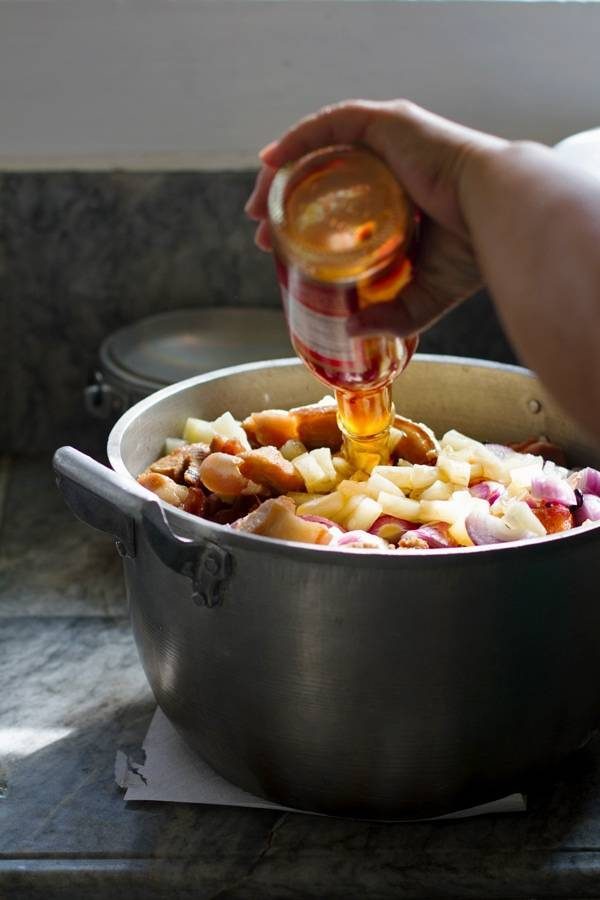
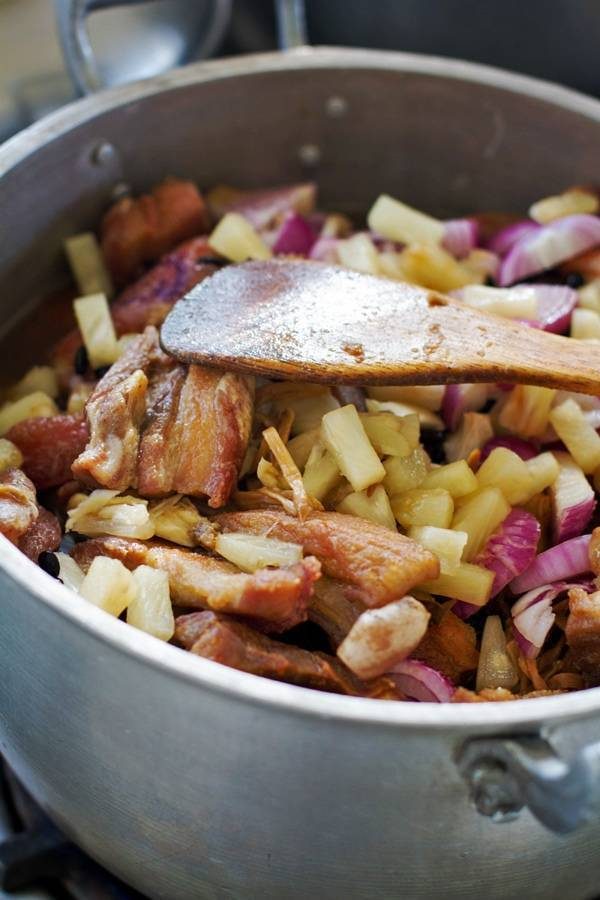
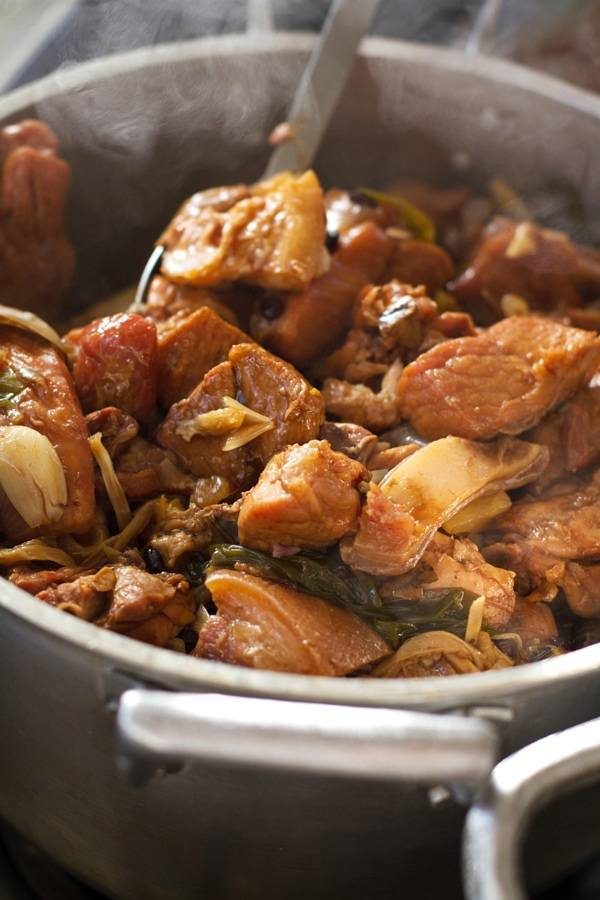
The CSC aunties’ Humba was so juicy, 100% fall-off-the-bone tender, and just completely saturated with rich, sweet flavor. In that pot we’ve got the fried pork belly, a sweet and salty sauce that wants to be soaked up by steaming white rice, pineapple, black beans, and green onions. You can kind of see through the progression of pictures that by the end, this meat is like a deep caramel golden brown. That, my friends, is the color of delicious.
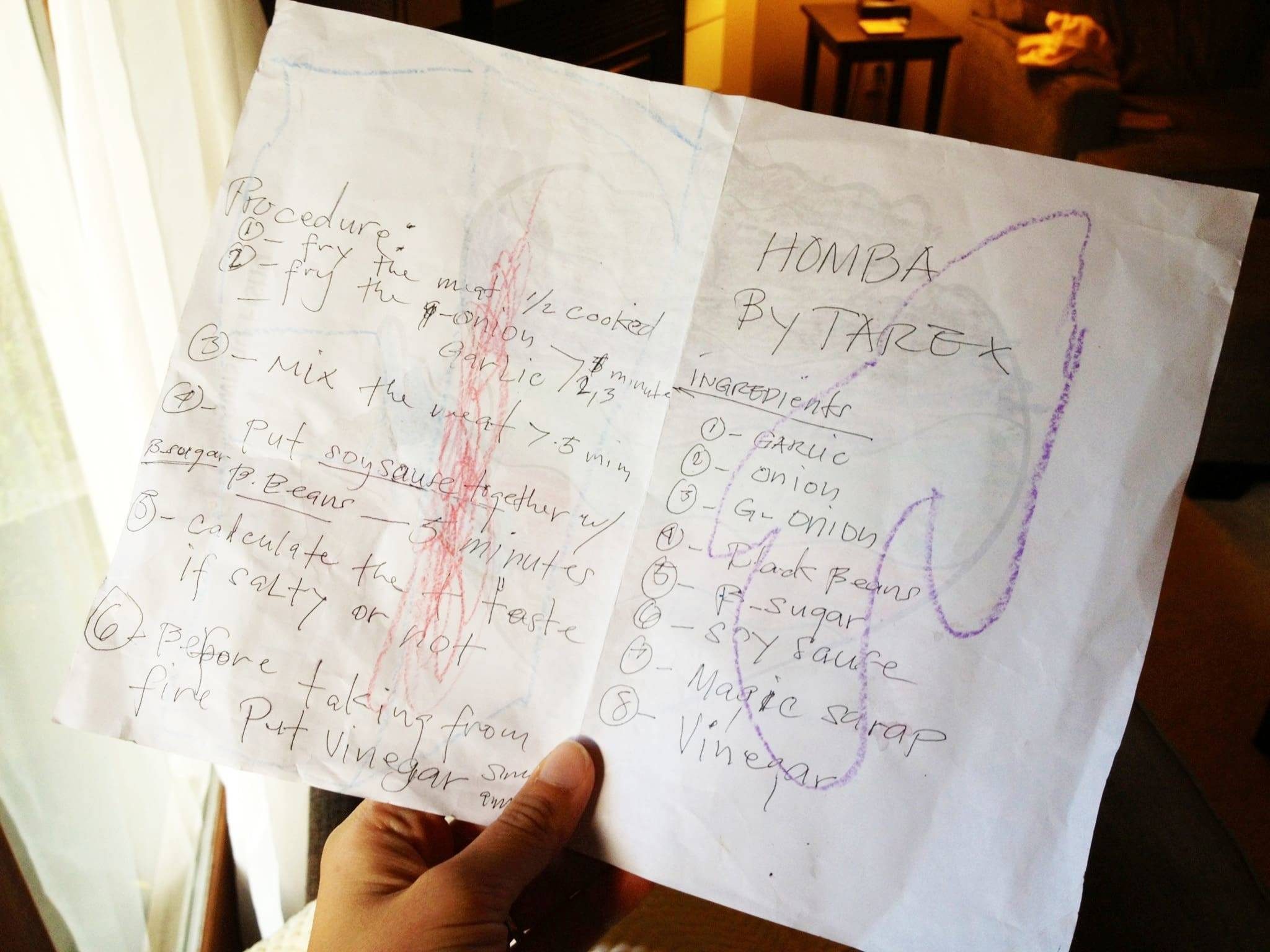
My most beloved Humba recipe (although not the one used for this post) was given to me by one of the house fathers, Tarex. I’m pretty sure he noticed me harassing everyone for their Humba recipes and either wanted to help me out and/or put an end to the Humba recipe obsession. So one day when I was in the kitchen, he grabbed the only piece of paper he could find laying around which was obviously was totally crumpled and covered with crayon kid scribbles, and transcribed his own personal Humba recipe over the scribbles for me.
It’s hanging on my fridge and it represents for me the crazy sweet intersection of food and life and CSC. ♥
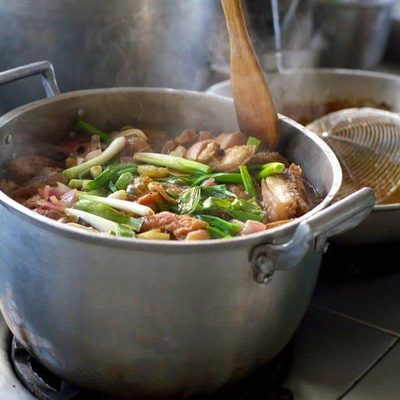
Filipino Humba
- Total Time: 1 hour 45 minutes
- Yield: 8–10 1x
Description
Filipino Humba! Super juicy, delicious pork belly fried up and tossed with a sweet and salty sauce. One of my absolute favorites!
Ingredients
- 2 lb. bone-in pork belly (the cut of pork should be part lean meat, part fat; it can also be boneless)
- 1–2 cups oil for frying
- 1–2 bay leaves
- 1 onion, chopped
- 1 tablespoons oyster sauce
- 2 tablespoons soy sauce (more to taste)
- ¼ cup pineapple tidbits
- ¼ cup black beans
- ¼ cup brown sugar
- ¼ cup vinegar
- 5 cloves garlic, peeled and smashed
- 1 ¼ cup water
- ½ cup green onions
Instructions
- Separate the fat from the lean meat by cutting the pork belly into medium-sized pieces (about 2 inch by 1 inch). Heat the oil in a large frying pan over medium low heat and cook the pieces of pork until golden brown, about 15 minutes. Remove from oil and drain in a bowl lined with paper towels.
- Transfer the pork to a large pot and add all the remaining ingredients except the green onions. Mix well and bring to a low boil over medium heat. Cover and simmer, stirring occasionally. After 30 minutes, add the green onions and stir to mix them into the pot.
- Cover again and simmer for an additional 30 minutes, or until the pork is very tender.
Notes
I do not recommend using any other kind of meat besides pork belly. I have tried this with several cuts of pork and they are never as good as the pork belly because they dry out much faster.
- Prep Time: 30 mins
- Cook Time: 1 hour 15 mins
- Category: Dinner
- Cuisine: Filipino
Keywords: filipino humba, humba recipe, fried pork belly
And just in case you need to watch an awesome video of my favorite kids in the world getting ready for their first day of school.
Which, you do.




Great Recipe.
Thanks.
I have used your recipe more than once. It is my favorite. Last time I didn’t have pineapple so I used a genorous amount of freshly squeezed orange juice and it was
DEE LISH US! LOL
I am making it again today for Super Bowl Sunday snacks! GO EAGLES!
Thank you and may God bless you always.
“(Bless the Lord, O’ my soul and ALL that is within me, bless HIs holy name. He has done great things!)”
Hi, Lindsay; I’m a little confused. I’ve never seen/heard of “bone-in” pork belly? It’s always, AFAIK, boneless. Also, you write “Separate the fat from the lean meat by cutting…”. How does that separate the two? Do you purposely cut out the fat, or do you mean to separate the belly meat & fat from the rind or hide? Thanks for your patience, attention and expertise!
Regards,
D.
Hi! Great questions. Lindsay used bone-in pork belly when she was living in the Philippines. For a visual of what separating the fat from the lean meat looks like, take a look at the second photo in this post.
Looks simple enough to cook. Just need the right amount and details for the recipe. Thanks for sharing!
Right now I’m in Sabang Danao City Cebu, in a few days I will be getting married to a wonderful woman that I love very much, she works very hard so I do a lot of the cooking as a white US retired person who has never cooked Filipino food before I’m learning fast and get a lot of compliments on my cooking, tonight I’m making pork humba again using your recipe this time, mine was good but I want to use yours this time as mine used not only the belly meat but legs and I wanted to try something different from mine. Yours sounds so yummy cant wait to taste it.
What is Azucena exactly. Tried looking it up and it says dog meat. By your substitution recommendation I’m gathering it’s a plant. I live in a very rural part of Az. But want to make this as authentic and I can. Can you please help me. Thank you in advance.
Hi Kathleen! It has been so long since the aunties at the shelter taught me how to make this recipe, so with some research and recall, my guess is that it was some kind of vegetable that they tried to name for me, and I tried to just write it down and give my best guess as to what it was (apparently, something similar to an onion). So… all that to say, I’m not completely sure. We’ve gone ahead and removed it from the ingredient list because we aren’t sure. But since it was only one tablespoon, and all your main ingredients are still there, it will be fine to omit. 🙂
Hi Lindsay,
Thank you so much and I really appreciated sharing our Filipino cuisine in your blog. It makes me so proud of being a Filipino.
Daghang Salamat! 🙂
ayyyy! just some of the comments here have become a little too judgmental and overly focused on the authenticity of the dish. As a Filipino, I give Lindsay high kudos for venturing into my culture and sharing these recipes to others unfamiliar with the Filipino culture. Thanks Lindsay!
That’s sweet, Rizzy. Thanks for the comment. 🙂
It’s my first time that I have visited your awesome food blog, I accidentally stumbled your site when i was browsing the net. on successful food bloggers. I just can’t believe that all these time I was looking in the wrong place, you got everything, guides and advice for a food bloggers.
What catches me most is your love to the Philippines, I am a Filipino and a Pinoy Food Blogger at that and I thank you…
I still need to read all your articles on your Living Abroad category, but I can’t wait any longer to speak my mind.
I can’t agree more that Humba is your favorite Pinoy food, it is sinfully delicious, it is also one of my favorite.
Thanks! I’ll pass this along to Lindsay. 🙂
My daughter just added Pinterest in my iPad & I love it. Humba is the one recipe that I have forgotten but reading this recipe took me back to Guagua,Pampanga. I lived w/ my dad & his wife for 4 years & I remeber her making this dish. The house smelled deliciously all day. I wasn’t too keen about eating pork fat during those days, but I’ve welcome it after having hum a. Yummmmy
My mom is from Cebu and she used to cook this. Your version is quite same of her dish but what we usually have is any part of pork as long there is fats but pork belly is the yummy one coz of the bone part and the dried banana blossom, if you like chili flakes add some of it and its really AWESOME!!!
Love this! Thanks for the comment Hayyanah!
After you cut the pork into chunks, do you use the fat or not? Kinda confused reading the recipe.
Love the ideas behind this dish; would never have thought to use pork belly with so many other strong flavours, and have never heard of humba (I’m from the UK so I guess it’s not common over here) but am super excited to try it out! Love the exciting new recipes/flavour combos on your site, it’s making for some fab procrastination time and giving me loads of things to add to my summer cooking list!
Thanks Rachel! Glad to hear that – I am the queen of procrastination so welcome to the club! 🙂 🙂
hi everybody,
I’m a filipino from Batangas and like othes said this is not a “real” humba recipe. The “real” humba ingredients are: ( I must call it “batangenyo humba” since reading comments I discovered that there are many versions of this dish)
ingredients:
-Pork’s head and/or Pig’s trotters (these will scare you more!!! 🙂 ) belly is ok too.
-bay leaf
-whole garlic (others put also chopped onion)
-pepper grain
-salt
-raw cane sugar
-tahure – i googled this and I found = It is a Filipino word. tahure in English is called soybean cake or fermented tofu.
-soy sauce
Usually cooked on earthenware pot (palayok) and the “secret” is the cooking time, must be cooked in low heat for long time, i think minimum 5 hours. I must say from morning to afternoon. 😉
if you are not in the Philippines and can’t find ingredients, tahure for example, you can do this.
– meat ( belly is ok)
– whole garlic (and chopped onion)
– sugar
– salt
– soy sauce
– bay leaf
– beer
Yes, like you said, there are many versions of this dish. I appreciate your feedback and you sharing what’s authentic to you.
So I guess pork belly doesn’t scare you by now. You must progress to using pork hocks and pork trotters. Imagine the humba you love, but with a sticky, gelatinous sauce that’s literally lip-smacking. Plus, you’ll have lots of tender skin but no thick layer of fat. It’s a win-win! 🙂
By the way, the humba I grew up with and still prefer has no pineapple and black beans, but I do use star anise.
Hello,
This looks amazing! Quick quesstion, at the beginning when you separate the fat from the meat, do you dispose of the fat pieces or include them in the pot for flavor?
Thanks so much can’t wait to try this!
Jenni
Hmm, I’m trying to remember now what the aunties did. I *think* they left the fatty pieces in there, but that’s probably because they really enjoyed eating the fatty pieces whereas here in the states, most people I know (other than my Filipino American brothers) would not want to eat the fat. So I guess it’s up to you!
Hey! this looks so great, I would love to make it this week, but I am curious about the black beans. Do you mean Mexican style black beans (beans that are black) or Asian style fermented black beans — the fermented edamame that turns black from the process?
Thanks!
Liz
I want to try this but will bake the pork instead. Thanks!
HUMBA is humot na baboy in bisaya and cebuano people in mindanao humba don’t have pineapple but in visayas area like cebu the humba has pineapple the Bohol humba it has unripe baby jackfruit on it it’s because the aroma of the pork while browning the meat with skin on kept relishing the natural oil makes it the aroma that’s why older people called it Humba it’s from the 2 [two] words humot na baboy now became humba
Is this a Cebu thing? I’m part filipino and have not heard about this dish. I guess I have to try it sometime.
Yes! it’s a dish specific to the Visayas region. 🙂
Hi Lindsay, I love this post! I personally think pork belly is the best part of the pig. In Korea they eat samgyeopsal on the regular, usually sliced and grilled over hot coals or simmered with aromatics and then sliced or even as a spicy stir fry with Korean chili paste. Your recipe made me think of my (other) hometown of Seoul.
This looks amazing! My mouth is watering at the flavors.
Of course there are many variations of this dish in different parts of the Philippines (especially Visayas and Mindanao). But it actually has Chinese origins, similar to braised style of cooking meat. Marketman (one of the Filipino food bloggers actually has several variations, of which this is more similar to my mother’s side of cooking Humba >> http://www.marketmanila.com/archives/humba-or-umba-braised-pork-with-palm-sugar-and-black-beans while another recipe of his on Humba is almost similar to yours, and what we mostly see in fiesta tables across Visayas and Mindanao >> http://www.marketmanila.com/archives/chinese-style-braised-pork-a-la-marketman
I knew I shouldn’t have clicked on this post while hungry.
Argh / YUM.
This looks absolutely delicious! Love that you share recipes of authentic Philipino food. Pork belly doesn’t sound so bad. At least you KNOW which part of the animal you’re eating. 😉
I’m all caught up on the pork -belly drama. . . hesitant, you know? But it’s true – all the cool kids are doing it. I can tell it must be mouth watering though, just from the pics. And quick question – why do you spell it hUmba, but Terex spells it hOmba? Is there a difference? Ooo – also, love the cake-pan deep dish dessert pizza! 😉
Good question – I have always seen it spelled Humba and then he wrote Homba for some reason. Spelling in the Philippines is funny because it kind of just depends who you ask… I found that there weren’t always set spellings for words.
Regarding the spelling of the Humba and Homba, it depends on which region the speaker comes from. Usually from the Visayas or Mindanao region, O is sometimes pronounced as U, as U is sometimes pronounced as O.
In Luzon or the Tagalogs, they jokingly say that you are “Bisaya” if you do that. Actually, even Ilocanos from the Northen part of Luzon do that sometimes. By the way, I am from Mindanao and can speak Bisaya or Cebuano.
Anyhow, I like your blogs on Filipino recipes.
Could be because of which part of the region you are living. There are over 100 languages in the Philippines. There are words that are have the same meaning, sounds the same but spelled differently.
Hi Lindsay!
I’m from the Philippines as well, Batangas City is my hometown. My family also make this recipe minus the pineapple. And it’s a staple during fiestas. 🙂
It is spelled Humba. Most Cebuanos and other Filipinos from the Visayas and Mindanao Region sometimes spell and pronounce words spelled with U (“ooooo” sound) as an O (“o” sound in ostrich). That’s why they sometimes spell and pronounce HOmba instead of HUmba. It’s a regional accent thing. 🙂 Hope this helps.
Thank you for featuring Filipino food. It’s about time the world knows our delicious food. Btw, have you tried Cebu lechon? I hope you did. It’s the bomb!
We definitely spelled it with a ” u ” in it. Yup, Lindsay, have you tried our Cebu Lechon. It is the best in the country. Also, how about dinuguan . The blood stew ( i am not sure if that is the English name for it, but my Filipino friends said it is), one with pork blood? I am going to post dinuguan in my blog before Halloween. And balut? Had you tried it? I am missing PI so badly. Btw thanks for the good work you do for the CSC kids. blessings.
BEST IN THE WORLD! Ask Anthony Bourdain 😉 proud Talisay, Cebu Native over here.
Lindsay, yummy pointed me to your blog . thank you so much. GREAT PHOTOS 🙂
I did! YUMO.