Hiya!
Bjork here, sending you greetings from St. Paul, MN! Fun fact: St. Paul was originally known as Pig’s Eye. Too bad that’s not still the case, huh? Wouldn’t it be awesome to address a letter to Pig’s Eye, MN?
Lindsay and I were both born and raised in Minnesota. High school sweethearts, as a matter of fact! So what am I doing writing a post on Lindsay’s blog? Well, other than provide some fun facts about St. Paul, I also provide a sneak peek into what’s happening behind the scenes at Pinch of Yum. You can check out last month’s post if you want to hear the story of why we started doing these reports.
Here’s a quick explanation of why we continue to do these every month:
- They help us learn.
- They keep us accountable (to ourselves and to you, the readers).
- They (hopefully) help other bloggers learn and grow their blogs.
- They (hopefully) communicate the fact that building a blog into a full-time income is possible.
Regarding that last point: I want to be intentional to point out the fact that while it’s 100% possible to build a blog and create an income, it’s 0% easy. It takes an incredible amount of hard work, dedication, learning, and even a little bit of luck. Keep in mind – there are two people working on Pinch of Yum and Food Blogger Pro. Pinch of Yum is Lindsay’s full-time job and a part-time job for me (along with Food Blogger Pro). We point a lot of our resources (both time and money) into these websites and we’ve been doing so for almost five years now.
What I’m trying to say is this: don’t be too hard on yourself if you’re still in the “figuring this thing out” stage of your blog. We were in that stage for a long time. In many ways, we’re still in that stage.
What’s the best way to move through the “figuring this thing out” stage?
Enjoy the process. Set realistic goals. Learn something new every day. Don’t expect perfection. Make small improvements. Celebrate your little victories.
Let’s take a look at the numbers for July.
A quick note: Some of the links below are affiliate links. All of the products listed below are products and services we’ve used before. If you have any questions about any of the income or expenses you can leave a comment and I’ll do my best to reply.
Income
- Tasty Food Photography – $7,243.45
- Bluehost – $4,945 –> this income comes from a page where we show people how to start a food blog in three steps.
- BlogHer (now SheKnows) – $4,405.01
- sovrn – $3,368.19
- Go Sugar Free Course – $3,019.73
- Sponsored Posts/Speaking – $1,400
- Yellow Hammer Media – $1,256.17
- Ziplist – $1,171.84
- Swoop (via BlogHer) – $939.71
- Gourmet Ads – $784.34
- Everyday Healthy eCookbook – $684.90
- Google AdSense – $641.49
- Genesis Theme – $630.00
- Say Media – $511.65
- The Creamy Cauliflower Sauce eCookbook – $487.80
- How to Monetize Your Food Blog eBook – $227.50
- SkimLinks – $111.84
- Elegant Themes – $99.00
- Thesis Theme – $65.01
- AWeber – $17.10
Total Income: $32,009.73
Expenses
- eBook Affiliates – $2,060.14
- Food Expenses – $616.43
- PayPal Transaction Percentage – $485.30
- Travel Expenses – $476.40
- Amazon S3 and Cloudfront – $386.14
- Media Temple (Hosting) – $350.00
- Support Staff – $318.75
- Classes/Education – $138.00
- Photography Props – $125.00
- Kitchen Supplies – $50.34
- CrashPlan (Computer Backups) – $150.00
- MailChimp – $105.00
- WP Site Care – $99.00
- LeadPages – $67.00
- Adobe Creative Cloud – $53.55
- PayPal Website Payments Pro – $30.00
- ViralTag – $28.00
- QuickBooks – $26.95
- Time Doctor – $19.98
- E-Junkie – $18.00
- VaultPress – $15.00
- Google Apps – $5.00
Total Expenses: $5,623.98
Total Income: $26,385.75
If you’re interested in learning more about some of the ways that you can monetize a food blog, we encourage you to download this free ebook, “16 Ways to Monetize Your Food Blog,” from our sister site, Food Blogger Pro!
Thoughts On Income
Tasty Food Photography
Lindsay’s eBook, Tasty Food Photography, was the big winner for July. If you’ve read any of the past income reports you know that we’re big fans of creating your own product. Why? Because having your own product gives you control of:
- Pricing
- Advertising
- The Sales Page
All three of these things played into Tasty Food Photography’s success for the month of July.
Let’s take a look at each one:
1. Pricing
It sounds obvious, but when you have your own products you can set your own prices.
Want to sell your product for $29? No problem. Want to add a bonus offer during a certain time of the year? You can do it. Want to have a sale at the end of the month? Go for it.
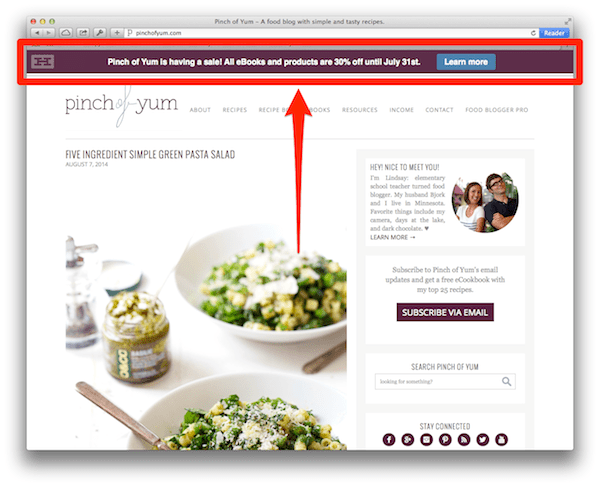
At the end of July, we had a short sale where we offered 30% off of Pinch of Yum and Food Blogger Pro products. The discount code was shared in Lindsay’s post on taking the perfect pour shot and in a Google Hangout On Air on food photography that Lindsay participated in (and if you want to check out the video of that, it’s included in the perfect pour shot post). We also created a Hello Bar notification at the top of the blog to notify readers of the sale:
I’ve noticed an interesting trend when we’ve run sales like this for both Food Blogger Pro and Pinch of Yum. See if you can notice the pattern in these two screenshots:
Food Blogger Pro sale from November 2013
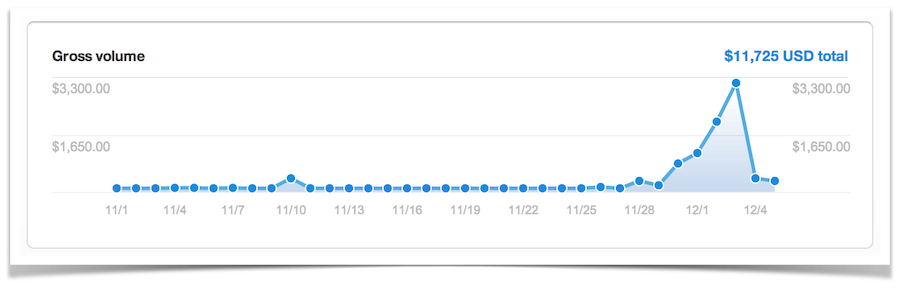
Tasty Food Photography sale from July 2014
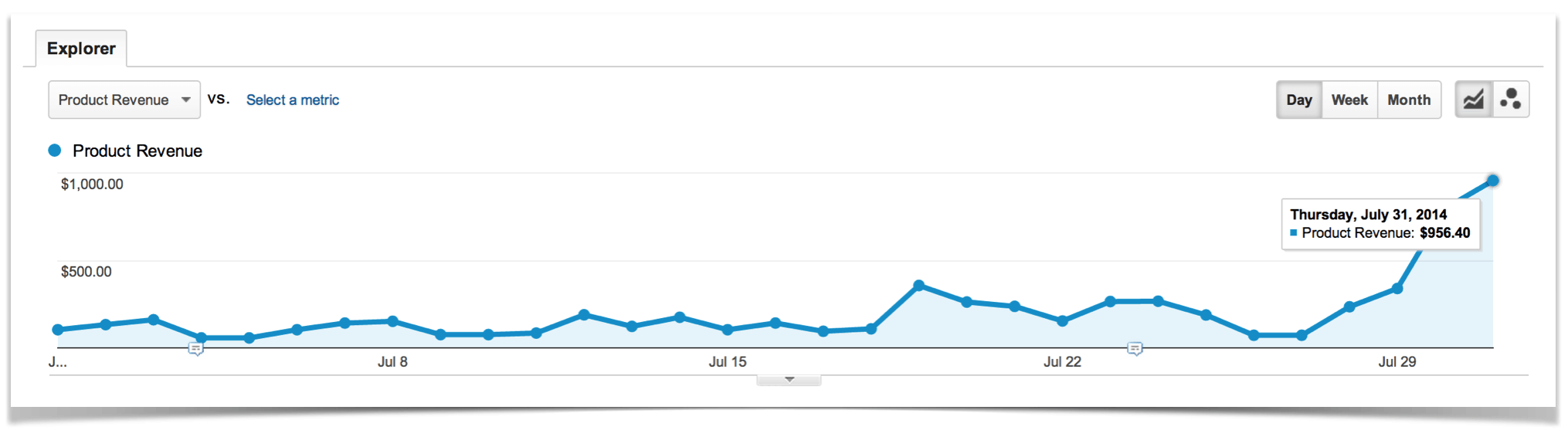
Do you see the trend? There is a huge spike in sales on the last day.
The graphs above help explain why certain companies are running sales all. the. time. For example, think of your local furniture store. Got it? Now open a new browser window and go to their website.
Are they having a sale? My guess would be yes, and I’d also guess that the sale is for “this weekend only.” Or maybe more appropriately put: “THIS! WEEKEND! ONLY!”
Why do they do this? Because it works. It creates a sense of urgency and people feel like if they don’t buy it THIS WEEKEND! then they’ll never again have a chance to get a deal that good.
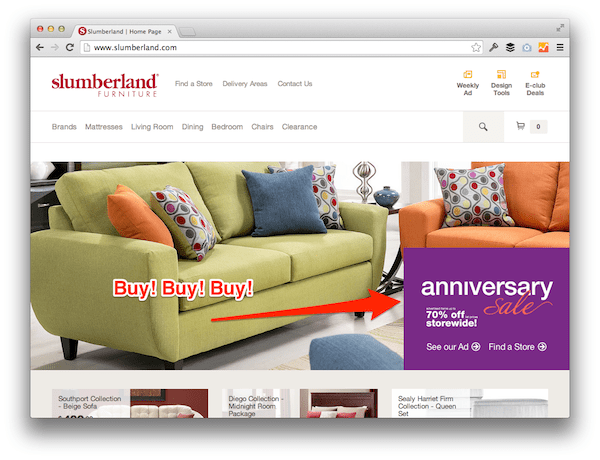
So why not run sales all the time when you’re selling your own product on your blog? Because blogging is different than furniture sales.
What? You knew that already? Okay, you’re right. That’s kind of obvious.
Let me rephrase that statement to make it less obvious: Because online currency is different than offline currency.
When you run a furniture store, the most important currency is cash. When you run a blog, the most important currency is trust.
Last winter we bought a new couch to complete our sofa set (you can see the incomplete set in this post if you’re looking for a visual). After finding the right color and size we advanced to the next (dreaded) stage of the purchase process: negotiation.
I asked the sales person if it was possible to get a discount. She said that the couch is priced at the lowest possible price. I asked again. She said it’s already on sale. I asked again. She said she’d have to call her manager to get an exception (and asked me to please not tell anyone about it, because she was bending the rules for us). She stepped away from her desk, maybe or maybe not called her manager, and then came back and let us know that she convinced her manager to give us a better discount.
Have you ever been in a situation like that?
Did you trust that salesperson more or less after the conversation?
If you’re advertising something as a certain price but you’re always discounting that product in order to get more sales, then people won’t trust that you’re telling the truth about your price. Your cash account might get a little bit bigger, but your trust account shrinks a little bit. And the trust account is the one that’s most important as a blogger.
So how to do you combat that?
Make sure that your price is your price and a sale is a sale, and in all transactions think first about how it will impact your trust account, not your cash account. Sales have a time and a place – just make sure that you don’t abuse it and sacrifice the trust of your readers. With Pinch of Yum and Food Blogger Pro, we aim for running a sale about once a quarter, but it usually ends up being even less frequent than that.
2. Advertising
We don’t have an advertising budget for any Pinch of Yum ebooks, but we do pay for advertising.
How does that work, you ask?
We only pay for advertising after a product is sold, never before it’s sold. We can do this because of affiliate marketing.
This was one of the factors that played into the higher number for Tasty Food Photography in the month of July. A Tasty Food Photography affiliate who has a popular blog promoted the eBook to her audience during July, which resulted in an increase in the sales numbers. We split this income 50/50 with the affiliate, but because we always pay after a sale occurs, we never have to worry about spending more on advertising than we make back in product sales.
It’s a win-win! The affiliate earns an income based on how many books they sell and we sell more product because the affiliate promoted it.
Creating your own product that has an affiliate program is a great way to create an income for your blog, especially if you’re looking to earn an income when you’re just getting started. If you want to learn more about using affiliate marketing to help sell a product, check out this post on the FBP blog.
3. The Sales Page
When you have your own product you have control over all of the steps in the sales process, including the sales page. This was an element that had a huge impact on the overall success of Tasty Food Photography in the month of July, as our new sales page performed way better than the old one.
The image below shows a Google Analytics screenshot. These stats are comparing the old sales page to the new sales page. The important thing to note is the last column called Page Value.
The average page value for the old sales page was $0.17 per visit.
After updating to the new sales page that increased to $.52 per visit.
I assume that the sale at the end of July helped to bump that number up a bit, but it’s still confirmation that the new sales page is performing much better than the old one.
Check out last month’s report if you want to see screenshots of all the updates we made to the sales page and explanations as to why we made them.
Tablespoons, Measuring Cups, and Buckets
A concept that Lindsay and I have been thinking about this month is the idea of the tablespoons, measuring cups, and buckets of food blog monetization.
Imagine that you are trying to fill a pool with water. Your goal is to fill it completely in one year. You have the choice between using tablespoons, measuring cups, or buckets. Which would you rather use?
Probably a bucket, right?
But what if I told you that you had to wait six months before you could start using the bucket, and three months before you could start using the measuring cups? Is your best choice the tablespoons?
You have to ask yourself a similar question when you think about how you’re going to create an income from your food blog. The pool represents the potential earnings from your blog, and the tablespoons, measuring cups, and buckets are how you earn that income.
1. Tablespoons

Tablespoons are your free content. This blog post is a tablespoon. A podcast is a tablespoon. An email update is a tablespoon.
The wonderful thing about tablespoons is you can start using them right away, and while it’s possible to create an income from tablespoons (through the use of ads), the reality is that it takes a lot of them to fill the pool.
This is the only tool that most bloggers use to fill the pool. There’s nothing wrong with this, it’s just important for new bloggers to understand that it takes a long time until you’re able to fill the pool using only tablespoons.
2. Measuring Cups

Measuring cups are products that you create (or sometimes products that you promote via affiliate marketing). Measuring cups are in the $5 – $99 dollar price range. Tasty Food Photography is a measuring cup. The how to start a food blog page is a measuring cup. Everyday Healthy is a measuring cup. Food Blogger Pro is a measuring cup.
It’s much easier to fill the pool with measuring cups, but implementing measuring cups on your blog means that you have to either:
- Slow down your use of tablespoons for a while (i.e. stop producing free content so you can focus on creating a product) or continue to use tablespoons while also building your measuring cup (i.e. continue producing free content while building a product in your “free time”).
In other words, building a measuring cup requires you to stretch yourself above and beyond your already maxed out schedule in order to find time to create a product. This is why so few people end up implementing measuring cups in their effort to fill the pool.
Again… this is totally okay. It’s not bad if you don’t create a product or implement some type of affiliate product promotion on your blog. But as you ponder the idea I’d challenge you to take the “15 minutes a day” approach. Block out 15 minutes a day and work on something valuable that you can eventually offer to your readers. I think you’ll be surprised at how far you’ll get if you just dedicate a little bit of time every day.
3. Buckets

Buckets are high-end products or services. Buckets land in the $100 – $1,000 price range. You’ll usually see these as information-based products, but it’s also possible for a bucket to be a service you offer. The closest thing to a bucket that we offer is a yearly membership to Food Blogger Pro, but in actuality, we don’t have a “real” bucket.
The awesome thing about buckets is that you don’t need that many in order to fill up the pool. If you have a $500 product, all it takes is 10 sales a month to make a really good income. We’d have to sell 263 copies of Tasty Food Photography in order to get to the same level! The pool will still get filled, we’re just doing it using lots of measuring cups instead of a few buckets.
The not so awesome thing about buckets is that they’re really hard to create. They almost always require a lot of time, or a lot of capital, or sometimes both.
Can you think of any blogs or websites that have used buckets to fill their pool? I’d love to hear about them in the comments section.
My Point
I wanted to bring this analogy up because I think it’s important to think about how you plan to fill your pool. Are you going to use tablespoons, measuring cups, or buckets? Maybe a combination of both? Maybe you want to work your way up by starting small and getting bigger. Remember, there’s no right or wrong answer.
Well, okay… there is a wrong answer, and that’s not doing anything. 🙂 So keep on keepin’ on!
Rpm
RPM stands for page revenue per thousand impressions. Or, in other words, RPM shows you the average revenue you earn from every 1,000 page views on your blog. It’s a helpful metric because it allows you to see how effective you are at monetizing your blog.
Below is the RPM that we had for Pinch of Yum in the month of July.

Traffic
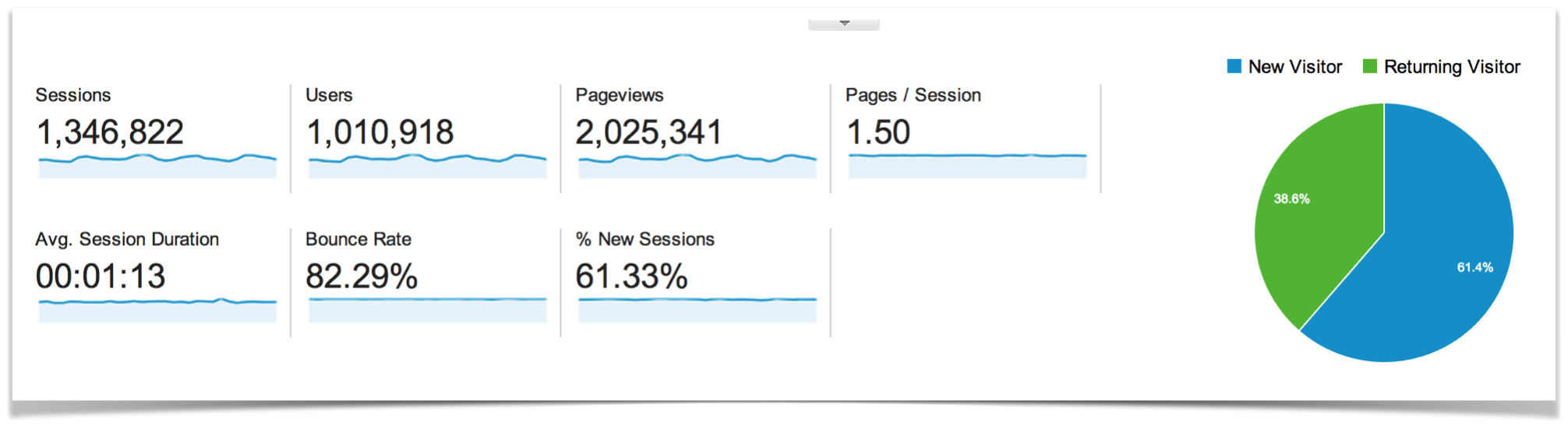
Below are some screenshots from Google Analytics. You can click on these images to view a larger size.
Traffic Overview
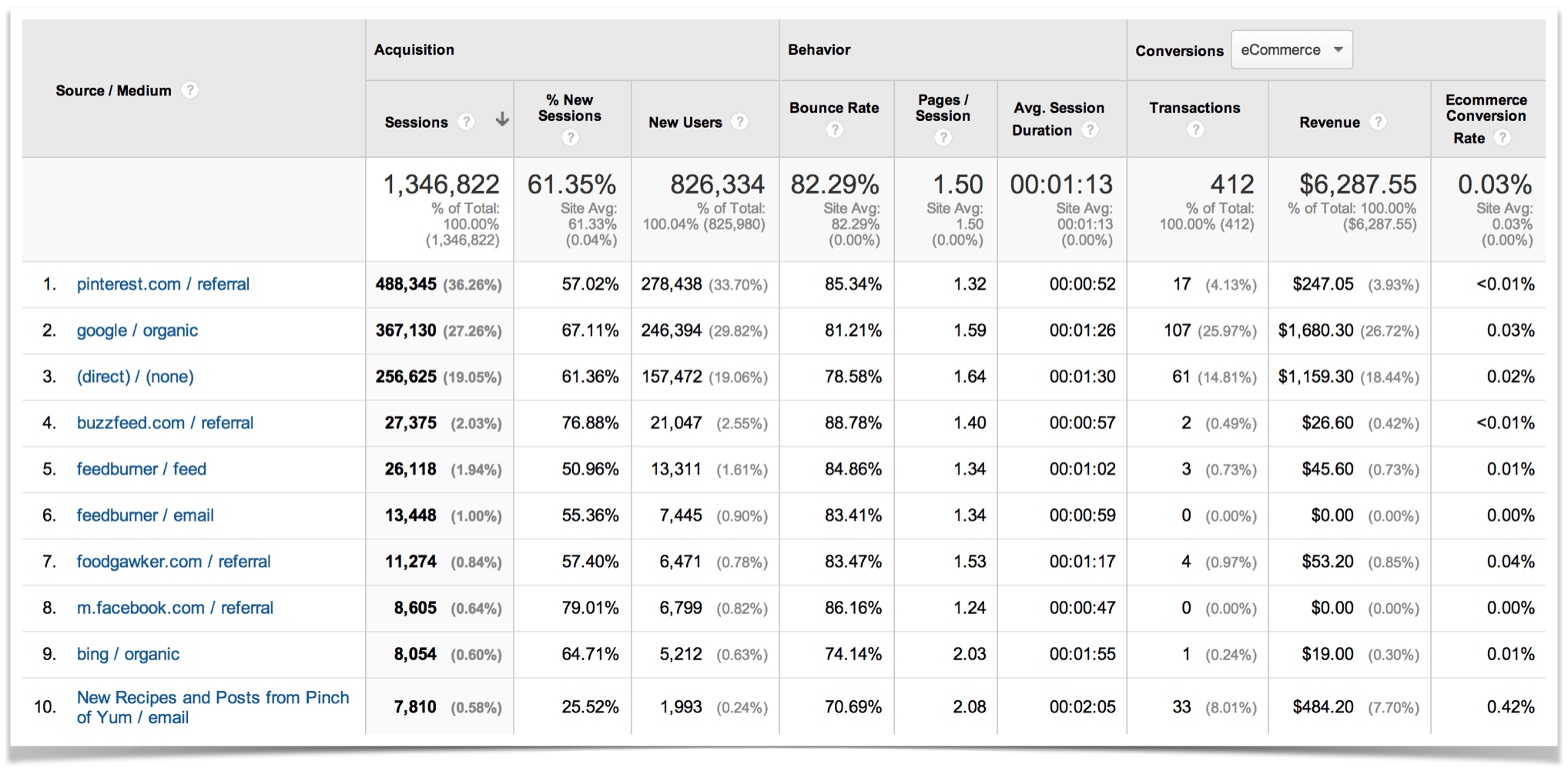
Top Ten Traffic Sources
Mobile Vs. Desktop Traffic
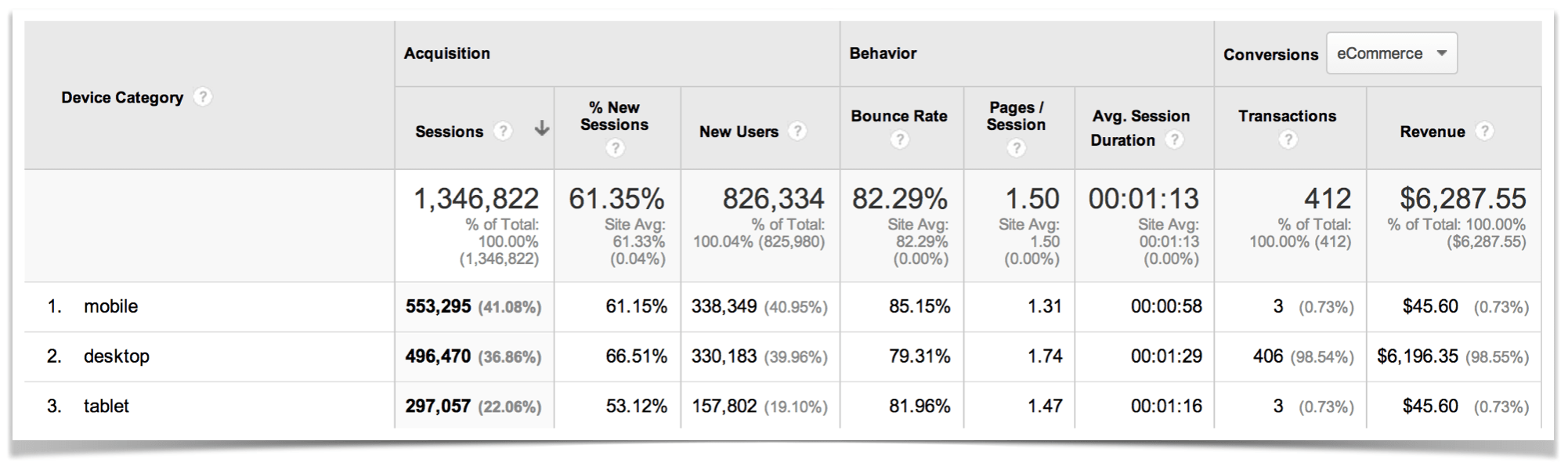
Thoughts On Traffic
Google Analytics, The App!

Just a heads up here: If you’re the type of person that obsessively checks things, whether it be your email, your Twitter feed, or your new concrete sidewalk that was just poured (speaking to myself here), then you might want to skip this tip. I’m just trying to protect you.
Google Analytics has finally released an app that you can download for your iPhone or Android device.
The best thing about this app is that it makes your blog’s analytics available at your fingertips. The worst thing about this app is that it makes your blog’s analytics available at your fingertips.
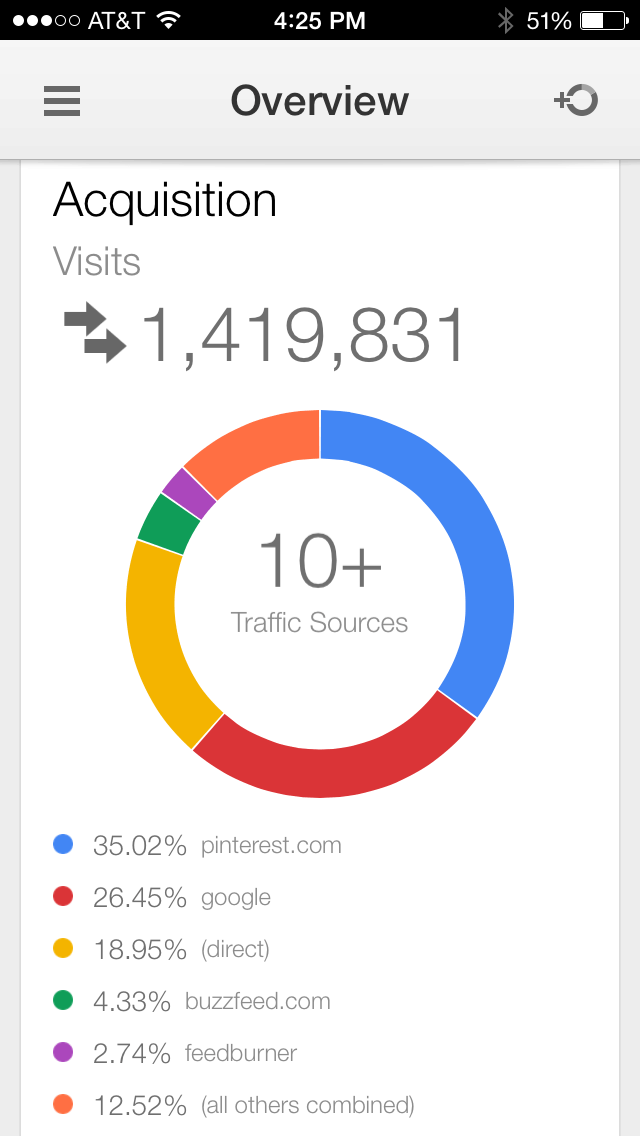
The reality is that if you’re in your first couple years of blogging, you probably shouldn’t spend a ton of time in Google Analytics. Your time is better spent focusing on user controlled analytics like creating high-quality content. While this app might be fun (and will impress your friends!), checking it every hour probably won’t help you grow your blog.
However, if you’ve been doing this blog thing for a while and your site is starting to become a source of income then this would be a good one to add to your collection of apps.
Here’s why:
Making sure your site is running okay
It’s not uncommon for me to get an email or a text that says “Hey! I think Pinch of Yum might be down.” Sometimes it’s true, but oftentimes it’s an issue with the individual’s computer.
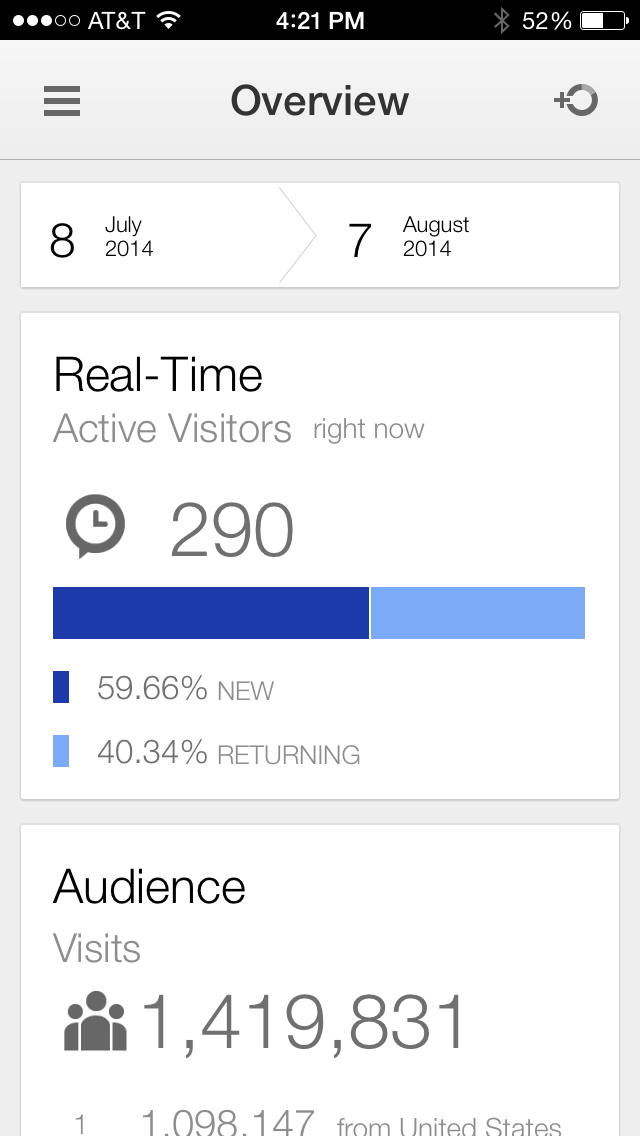
Having the Google Analytics app always me to quickly check and see if other people are able to access the site. I can do this by looking at the first number that pops up in the app, which is real-time analytics.
If I see that other people are currently using the site then I know that the site isn’t down.
Seeing data in new ways
Data, in and of itself, is pretty useless. It becomes useful when you use it to learn, discover, and improve.
One thing I’ve found while using the app is that there are a few places where data is communicated in new and unique ways, which helps me get a better understanding Pinch of Yum’s readership.
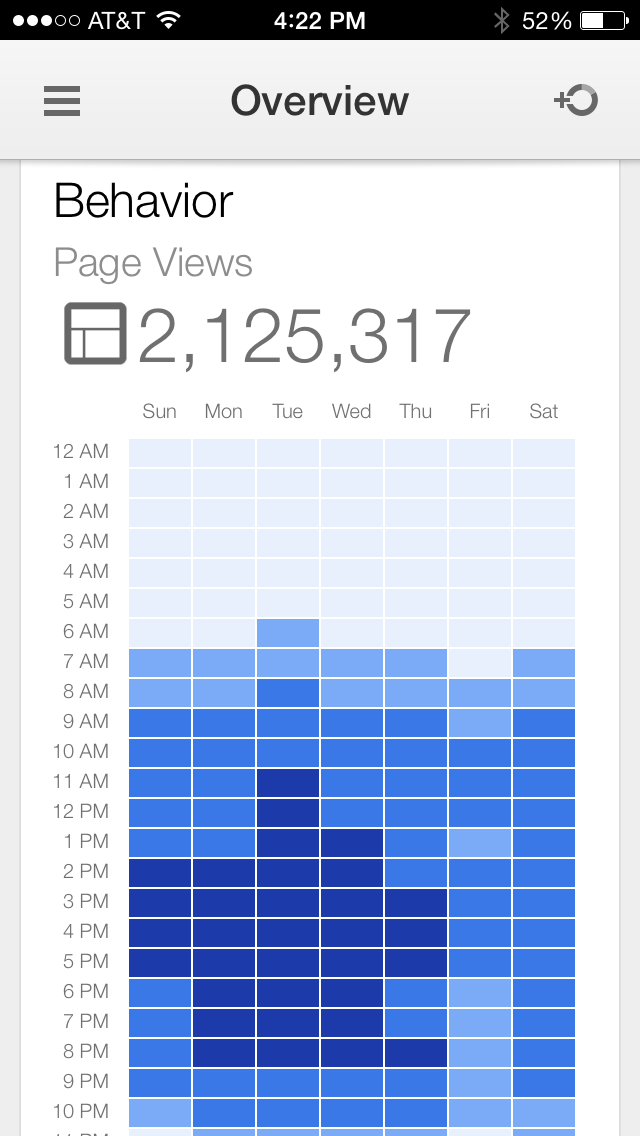
This graph on page views is an example of that. The different shades of blue show the different times of each day when page views are the highest.
Impress your friends
For some reason looking at real-time analytics on a phone is much cooler than looking at real-time analytics on a desktop. 🙂
Have you downloaded the app? What do you think? Have you found any other useful ways to use it or is it mostly just a distraction?
March Madness and The Summer Dip
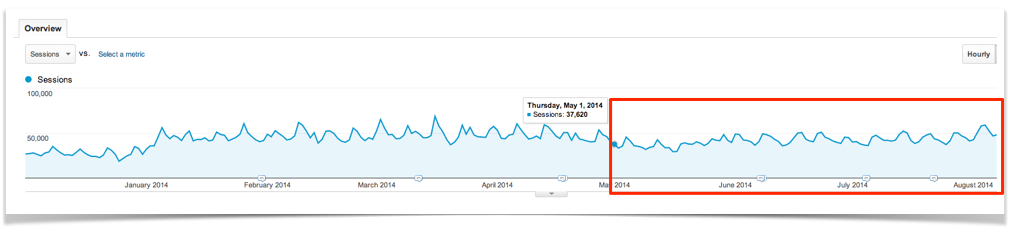
We noticed earlier this summer that POY’s traffic numbers dipped a little bit compared to the traffic in March-May. March 2014 was POYs highest traffic month ever, but traffic is starting to build back up now. I’m not sure if a slight summer dip is a trend that is true for other blogs (or food blogs, at least), but I thought it was interesting, and if I find something interesting I try and share it.
Recipe Schema Markup
That’s a mouthful, isn’t it?
Schema markup is a really important concept for bloggers to understand. I wrote a blog post about the topic on FBP, but I wanted to share the video here as well in case you missed it.
Because Of You
It’s really true. It’s because of you (yes, you!) that this thing we call Pinch of Yum can exist as it does today. Thanks so much for reading, tweeting, commenting, emailing, and sharing these recipes with your families and friends. We love hearing from you!
We’re using a portion of this month’s income from Pinch of Yum to support one of the special projects at the Children’s Shelter of Cebu, an incredible orphanage in the Philippines where Lindsay and I lived and worked for a year.

This month we’re supporting the Children’s Shelter of Cebu by helping to purchase food and supplies for the birthday parties. Every single kid at CSC gets their own individual birthday party, even the babies! This is a picture of sweet little Thomas (Lindsay’s description – although I will admit, he is pretty sweet) checking out his first birthday cake. Thomas has been through countless cranial surgeries and hospitalizations all before turning one year old, which makes us all the more thrilled to see pictures of him celebrating his miraculous first year with his aunties, uncles, and house siblings at CSC.
It’s one of the many ways that the orphanage goes above and beyond to show the kids that they are loved and cared for. You can learn more about CSC’s special projects by visiting this page on their website.



Thank you, Sir. It is really an inspiration for us. You have details described your income as well as its sources. I am always trying to grow my traffic. But after reading your post I am now like to focus on my traffic who visits not its quantity.
Thanks again.
Thank you so much for this post. It was really enlightening as a beginning blogger to see the work that goes into something so much larger and to have such an inside view. I really loved the measurements analogy. It’s a good thing, I think, to have in the back of my mind as I start out.
Hi Bjork,
I love these reports, so helpful!
I was actually hoping you might share (or if you already have, point me in the right direction), what your set up is/ any tweaks you’ve made to your Svorn & BlogHer banner placements.
I have a blog with about half the traffic your does, but we only get about 10% of the revenue from banner ads. Most of our traffic is US, and we have a similar mobile split to yours as well, but I am just left scratching my head as to why there’s such a HUGE difference.
Would love to hear any tips on this if you’d be happy to share? x
Thank you for all the valuable information that you share. Wishing you continued success. You deserve it !
Regards.
MJ
Hi Bjork and Lindsay, Great information here; thanks for putting together this list. In regards to Google AdSense, this is where you have various banner ads on your site and if people click on them, you make a certain profit from each click, am I right?
Google says this service is free, but, is it *truly* free? Also, does Google determine how much money you make per click–if someone clicks on a ad? Can the ads relate to what your site is about?
Thanks in advance for clarifying this,
Rob
I think you could very quickly create a bucket – a pretty huge bucket – by starting a Pinch of Yum Annual or Bi-Annual Live Event at an amazing location.
Do you already do that? It seems to me like the next, most natural progression for this brand…
🙂
We’ve definitely talked about it! I love the idea!
Thank you for disclosing and wanting to teach each month. Now that I’m full time blogging it helps me set new priorities. I don’t think I would feel comfortable sharing on my blog my income but I am going to purchase a dry erase board where I can start jotting down my monthly earnings and making them more visible besides my spreadsheets! Keep up the great work guys!
Great idea Katie! Thanks for the comment!
Hi guys, these posts are definitely helpful, so thanks for doing them. You might already know this but the “summer dip” you noticed might be related to the Panda 4 update Google rolled out in May rather than seasonality. You can compare month over month changes in traffic for the last few years to verify this, but in my case there was a 15% drop in traffic due to the Panda update. From what I’ve heard, some bloggers were hit much harder.
Ah yes! The dreaded Panda updated… Thanks for the comment Marc!
I am about to embark on my own little blogging journey (revolving around healthy food and weight lifting/exercise), and I’m just curious as to how you began yours. Did you start out with a free blogging host, or did you set out with your own domain name, hoping that someday you would switch to an income-generating model? Right now I’m playing around with blog.com and blogher.com, and I’m hoping you might have some insight for me. I know I won’t be making money any time soon, but I’d like to put something in place that will have flexibility in the future. Let me know what you think!
PS I hope you enjoyed your time at the Residences – I am the concierge who processed your checkout!
I just literally said “oh my gosh” out loud! Too funny – and thank you so much for being a part of our wonderful experience at the Residences! It was absolutely spectacular and all of you sweet reception girls were so friendly and nice. Best service around! 🙂
The short version of the story is that we didn’t start out with any intent to make money and we didn’t start monetizing until after about a year and a half of blogging. We started Pinch of Yum on Tumblr because we didn’t really have any big goals or dreams for the site, but in hindsight, I wish we would have started on WordPress (with our own domain and everything) right away. It was quite the process to switch everything over once we realized that we wanted to take the blog more seriously. I would love to share more and hear more about what you’re thinking for your blog – feel free to drop me an email and I can also point you to some podcast interviews that we’ve done that share more info about our start up story. 🙂 Thanks again Estes!
Just posted on your giveaway – as I’m sure you know, plane tickets to/from Aspen are pricey to say the least! I will definitely send you an email in the near future. Thank you for your response!
Thanks Estes! 😉
Analogy of tablespoons, Measuring cups and buckets is great. But before a blogger moves on to measuring cups or say buckets, previous step (tablespoons and measuring cups respectively) should have reached to a considerable mass.
Very nice! this is a very good result. Making money with a blog-eat, brilliant idea.
hi Bjork (and Lindsay!). Man oh man I am always so glad to pop over to your blog. The tablespoon, measuring cup and bucket analogy was solid gold. You guys are really great teachers, and I feel inspired – my “online shop” has been sitting dormant since April when I re-launched my site – but I am really pumped to add some fun things to it and try to make more of a living from my site. You are ever-inspiring and so helpful for so many of us bloggers out there! Thank you for doing what you do! (also – DYING of cuteness of Thomas and his birthday cake. That is truly special.)
Wow, pretty good month. Thanks for sharing with us and for all the tips on how we can do it too.
I’m also interested in knowing what “sovrn” is.
http://www.sovrn.com. I use them as my ad source, along with BlogHer. Nice thing is, they do not conflict with BlogHer. Before they became Sovrn, they were Federated Media, and they were in conflict if you had a BlogHer agreement (for ads). Sovrn says “What we do. We help you better understand your audience, engage your readers, and make more money. You create great content. We create tools to help you along the way.” I am looking forward to working with them as my second source and hope one day to be making the kind of income Lindsay and Bjork are. Nice people to talk with too. Even half I’d be thrilled!
Hi Bjork. First, thank you for being so transparent and helpful. What you guys share is truly remarkable. I need to study every one of these reports to improve my traffic and monetization. So much to learn, it makes my head spin.
I am still studying this post but have a quick question. I just applied to become a part of Ziplist (the branded version, now that i have enough uniques). Do you also earn income with the Shareasale portion of Ziplist? I don’t see it on your income report, so I am guessing not? I was going to apply for that too but am confused. Don’t want to over do the ad, as I am already with BlogHer and now Sovrn as you are. Thank you for taking time to respond. Hugs to you and Lindsay.
Like others, I am incredibly interested by these impressive reports, and very grateful that you’re sharing so generously. It’s giving me lots of ideas and pointers.
Would you be willing to share your current ad waterfall setup? Forgive me if this has already been addressed in earlier reports, but I wasn’t able to find the information, and this is the particular point I’m struggling to wrap my head around these days. Thank you!
It took a long time for me to scroll through all the love in order for me to comment here. It’s proof you’re doing something really great here! Although I can’t say I’ve read every post (as I’ve just stumbled upon the income reports about 3 months ago), I’ve read most of the entries. I’ve learned so much from them. Keep up the awesome work!
I have a question. Your 4th option on the income list is “sovrn”. What is that, and how have you warned income from it? Thanks in advance for your response. 🙂
*earned. I shouldn’t be doing this stuff on an iPad.
Oh yeah, and. Forgot to mention that I’m obsessed with the Google Analytics app! My page doesn’t have the seemingly massive numbers that yours does, but those are the little steps you keep mentioning, right? It’s inspiring. Maybe I’ll grow to your size one day!
Probably lots of people have said this, but thank you for your transparency and openness. So many bloggers i look up to hide all of the things you are openly sharing. I’m not afraid of hard work and research – but sometimes it’s just hard to know what is possible. You deserve every bit of your hard earned success!
It’s truly a nice and helpful piece of info. I’m satisfied that you just
shared this useful info with us. Please stay us up to date like this.
Thanks for sharing.
You all are just so smart. Seriously amazed at how well you’ve put together all this. I feel like a total idiot when it comes to this stuff. I wish I could get my blog to bring in more income. What I make compared to yall seems like pennies :-\
Hello Lindsey and Bjork:
I have been watching your blog growing from 2011 till now. I must say it loud “Both Lindsay and you did a fantastic job”(clap, clap,… clap). Your monthly reports are very very detailed and they depict your thirst of optimizing blog in every possible way. You guys have come up with different concepts and products over the time and showed the world that food blogging is not less(infact more) than any professional blogging all through your hard work and dedication. I could not resist myself from giving a great applause to both of you. You deserve this success and you deserve much more.
I hope you guys keep doing these awesome stuffs and earn even more. All the very best guys.
Sasi, India
Thank you so much, Sasi! I really appreciate that! Thanks for reading all the way from India!
Yes! Loved the Google Analytics section. I wish they had that behavior pageview heatmap on the desktop version because I find it super insightful. BUT I do wish you had the ability to do custom segments on mobile to be able to slice it out better.
Hello Lindsey and Bjork:
I agree that your Traffic and Income reports are very educational in this rapidly expanding world of blogging. We are all learning and although each blog may have a somewhat unique niche, we all share some common ground. Thank you for sharing.
I was thinking that you could offer an e-book on a collection of your Traffic and Income Reports. I am sure that many bloggers would purchase it.
Have a super rest of your week.
I recently discovered these reports through Elise Cripe’s blog and have found them so helpful and inspiring. Thanks!
Awesome! I was talking to a friend that recently heard Elise speak at WDS and said she did a great job. Did she mention POY in a post? Do you have the URL? I’d love to check it out.
Cool – the talk is not online yet but I’m excited to watch it when it comes out! She mentioned you in a weekly link roundup, here’s the URL: https://eliseblaha.typepad.com/golden/2014/08/weekend-links-29.html . Thanks for your response!
This is probably a stupid question, but where are your adsense ads? I’ve been using the “big rectangle” at the beginning of posts for years on one of my blogs (not the one linked to in my profile), but I am relaunching the site with a cleaner look and would prefer to not have those ugly ads in every post.
Our AdSense ads are passback for some of our sidebar ads. We don’t run any text based AdSense ads on the site.
Does that answer your question?
Fantastic reports! I’m not involved in food blogging but find these useful. Surprised you are getting better results from Lijit vs Adsense. I experimented with Lijit and only got about 50% RPM when compared to Adsense.
My guess is that food blog readers don’t click much? I’m guessing this because the bounce rate is high and Pages/Session and Duration seem low. Great traffic levels though!
Right on Paul. Clicks are pretty darn low when compared to other industries/niches.
I think that sovrn (i.e. Lijit) might have tiers based on traffic levels. I’m not positive, but that seems to be the trend when comparing stats and numbers with other bloggers.